| |
Why It's Called “Sucker Brook”
By Paul Lauenstein
 A
clear stream flows into Lake Massapoag. It's called Sucker Brook. You can find
it on Massapoag Ave. right beside the arch leading to the community center. A
clear stream flows into Lake Massapoag. It's called Sucker Brook. You can find
it on Massapoag Ave. right beside the arch leading to the community center.
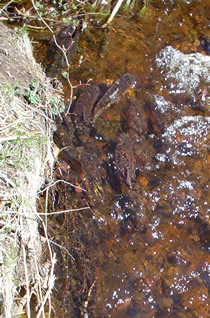
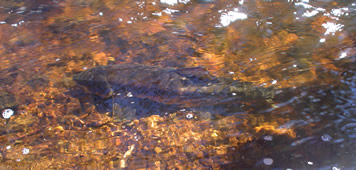
One sunny afternoon in mid-April I stopped by Sucker Brook and witnessed the
annual spawning migration of white suckers. Adult white suckers are fish about
a foot and a half long, weighing two or three pounds, and sporting a reddish
stripe along their sides.
They migrate from the lake up Sucker Brook every year in mid-April to spawn.
Like salmon, they fight their way upstream against a strong current until they
reach a suitable stretch of stony streambed. Then they align their bodies alongside
other individuals of the opposite sex. Fins extended, they shudder and release
their eggs, or milt. The fertilized eggs settle into crevices between the stones,
where they are oxygenated by the current. After they hatch, the fry drift back
down to the lake, where they take up their life struggle of finding food and
dodging predators.
Suckers play an important role in the ecology of Lake Massapoag. Young suckers
are food for game fish and birds. Adult suckers are scavengers, cleaning the
lake bottom like vacuum cleaners.
The streams flowing into Lake Massapoag typically dry up in summer. Sucker Brook
is the only stream that still flows year-round, but it is no longer a sure bet
that there will be enough flow every spring to support the annual sucker spawning
run. If we wish to maintain the complex web of life that surrounds and sustains
us, we must find ways to achieve a balance between our own needs and those of
the ecosystems we inhabit.
Back to Items
of Interest
|
|


